Load Balancing Basics
Load balancing is the process of distributing incoming network traffic across multiple servers to ensure no single server gets overwhelmed.
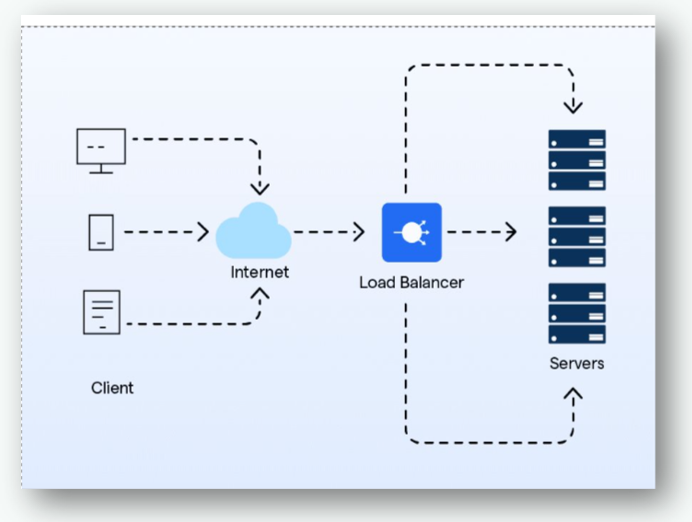
Why it matters?
- Improves performance.
- Increases reliability.
- Enhances user experience.
- Ensures uptime even if a server fails.
Load Balancing Methods.
- DNS Round Robin
- Least Connections
- Source
DNS Round Robin (DNS RR)
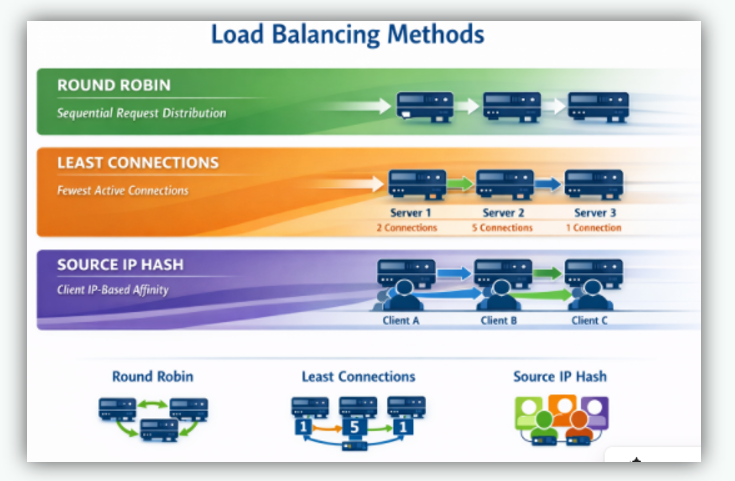
DNS Round Robin distributes client requests by returning different backend server IP addresses in response to DNS queries, rotating through the available records.
- Load distribution occurs at the DNS level, not within HAProxy itself.
- HAProxy can consume DNS resolved backend IPs, but does not control DNS round robin logic.
- Traffic distribution depends on DNS caching and client resolver behavior.
Use case:
Basic load distribution without session awareness, suitable for simple or external DNS based balancing.
Round Robin
Round Robin distributes incoming requests sequentially across all available backend servers.
- Each new request is forwarded to the next server in the list.
- All servers receive traffic evenly, assuming similar performance.
- Stateless and simple to configure.
Use case:
Best for environments where backend servers have similar capacity and performance.
Least Connections
Least Connections forwards new requests to the backend server with the fewest active connections.
- Dynamically adapts to backend load.
- Helps prevent overloading busy servers.
- More effective than Round Robin when server load is uneven.
Use case: Ideal for applications with long lived or variable duration connections.
Source
Source load balancing selects a backend server based on a hash of the client’s source IP address.
- Requests from the same client IP are consistently routed to the same backend server.
- Provides basic session persistence without cookies.
- Distribution may become uneven if traffic originates from a small IP range.
Use case: Useful when session persistence is required and cookie based stickiness is not available.
Summary Table
| Method | Description | Session Affinity |
|---|---|---|
| Round Robin | Sequential distribution | No |
| Least Connections | Least loaded server | No |
| Source | Hash based on client IP | Yes |